TubeSEO - Best YouTube SEO Keywords Research Tools
10 YouTube SEO Mistakes Killing Your Channel Growth (Fix Now)
Discover the 10 most damaging YouTube SEO mistakes hurting your channel. Fix these errors using free tools and watch your rankings and views improve fast.
YOUTUBE SEOFREE SEO KEYWORD RESEARCH TOOLSTUBESEO - SEO KEYWORDS RESEARCH TOOLS
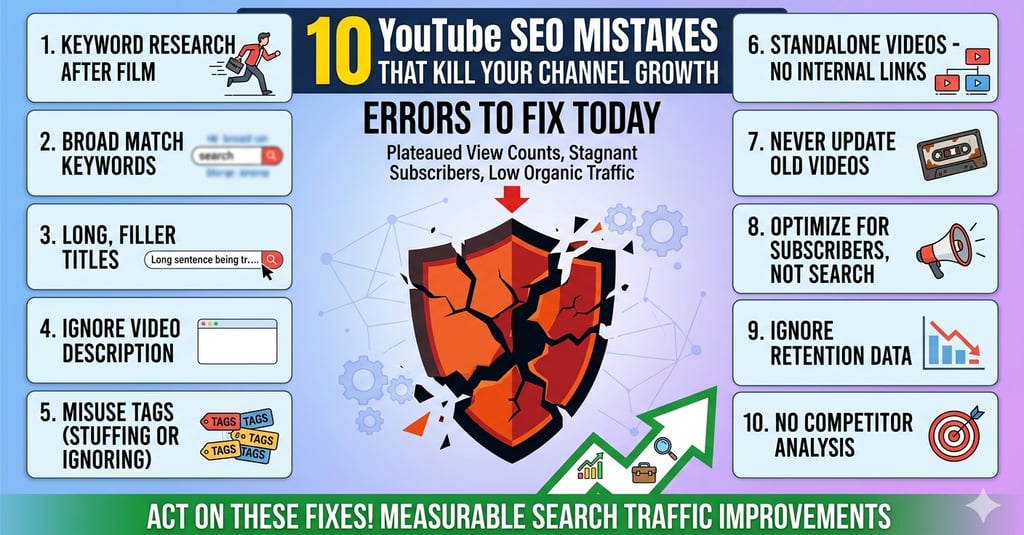
YouTube channels do not fail from a single catastrophic error. They fail from a collection of small, persistent mistakes that individually seem minor but collectively create a ceiling on growth that no amount of additional content production can break through. A channel making five of the ten mistakes in this guide will plateau at a view count and subscriber level far below its content quality deserves — and the frustrating part is that from the outside, there is no obvious explanation for why the channel is not growing. The content looks good. The topics seem relevant. The thumbnails are fine. But the underlying SEO foundation has enough cracks to prevent the channel from ever reaching its potential.
This guide identifies the ten most damaging YouTube SEO mistakes that consistently hold channels back in 2026, explains exactly why each mistake hurts rankings and growth, and provides the specific, actionable fix for each one. Most fixes take less than an hour to implement, and several can produce measurable improvements in organic search traffic within 30 days of correction.
Work through this list honestly. The most valuable thing you can do as you read each mistake is ask not whether it sounds theoretically familiar, but whether your channel is actually making it right now.
Mistake 1: Starting Keyword Research After You Film, Not Before
This is the most pervasive mistake in YouTube content creation, and it fundamentally undermines the SEO value of every video it affects. The typical workflow for creators making this mistake looks like this: a topic idea emerges, filming and editing happen, and then keyword research is conducted to find relevant terms to insert into the already-finished video’s metadata. The problem is that at this stage, the title and description can be optimized around a keyword, but the video itself — the spoken content, the structure, the specific angle covered — cannot be rebuilt around a different keyword if the research reveals a better opportunity.
Keyword research conducted after filming is reactive metadata insertion, not genuine SEO. Genuine SEO begins with the keyword: you research which specific query your target audience is making, you film content specifically designed to be the best answer to that query, and you optimize the metadata to precisely reflect the keyword-topic alignment you have built into the video from the ground up. This approach produces videos that are inherently more relevant to their target keyword because the content was created to satisfy a specific search intent, not retroactively labeled to match one.
The fix: Make TubeSEO’s Keyword Research module the first step of your production workflow, not the last. Before pitching, scripting, or filming any video, spend 15 minutes researching the topic in TubeSEO to identify your primary keyword, validate its search demand, and note the secondary keywords that will guide your content structure. Every video produced after this step will be more precisely aligned with its target keyword — and that precision compounds into meaningfully stronger search rankings over time.
Mistake 2: Using Broad Match Keywords Instead of Exact Phrases
When creators do conduct keyword research, the most common error is identifying a broad topic area as the keyword rather than the specific search phrase real viewers use. “YouTube SEO” is not a keyword — it is a topic. “Free YouTube SEO tools for beginners 2026” is a keyword: the specific, multi-word phrase that a real viewer would type into YouTube’s search bar.
This distinction matters because YouTube’s ranking algorithm evaluates title and metadata relevance against exact search queries. A video titled “YouTube SEO Guide” will rank poorly for the query “free YouTube SEO tools for beginners 2026” because the title does not contain the specific phrase. A video titled “Free YouTube SEO Tools for Beginners (2026 Complete Guide)” is an exact match for the same query and will rank significantly higher, all else being equal.
The fix: When using TubeSEO for keyword research, look at the specific related keyword phrases in the suggestions output — these are the exact multi-word phrases that real viewers search, not just the broad topic area. Select your primary keyword from these specific phrase suggestions, not from the broad seed topic you started with. Your title should contain this exact phrase, not a paraphrase of it.
Mistake 3: Writing Titles That Are Too Long or Start With Filler Words
Title length and structure directly determine how much of your title is visible to viewers in search results and whether the keyword appears in the high-weight early position. Both errors are common and easy to fix.
Titles over 70 characters get truncated in most search result contexts. A title that reads “How to Do Complete YouTube SEO Keyword Research Using Free Tools in 2026 for Small Channels” is 91 characters — the final 21 characters (“for Small Channels”) are invisible in most search contexts. If “for Small Channels” was an important specificity signal intended to differentiate this video for a beginner audience, it is wasted.
Filler word openers are equally damaging. Titles beginning with “In this video,” “Today I’ll show you,” “Welcome back to,” or the channel name all push the keyword to a later position in the title — reducing its algorithmic weight and reducing the chance that a viewer scanning search results sees the relevant keyword before the title is truncated.
The fix: Write titles that begin with or immediately adjacent to the primary keyword. A target title length of 50 to 65 characters ensures full visibility without truncation. Cut every filler word that precedes the keyword. “Free YouTube SEO Tools for Beginners: Complete 2026 Guide” is 57 characters, begins with the keyword, and contains all the essential information within the visible window.
Mistake 4: Ignoring the Video Description Almost Entirely
The symptom of this mistake is a description that reads like: “In this video I talk about YouTube SEO. Hope you enjoy! Subscribe for more content.” This two-sentence description provides YouTube’s algorithm with minimal keyword context, gives the viewer no useful information for deciding whether to watch, and misses 5,000 characters of keyword and content coverage opportunity.
YouTube reads the full text of your description as a keyword and topical relevance signal. A two-sentence description tells the algorithm that your video covers one specific term. A 300-word description structured around your keyword cluster — using TubeSEO’s secondary keyword suggestions throughout the body text — tells the algorithm that your video provides comprehensive coverage of a topic area, which improves rankings for multiple related search queries simultaneously.
The fix: Apply the three-layer description structure outlined in our dedicated description optimization guide. Begin with the primary keyword in the first sentence, write 200 to 300 words of genuine content summary using secondary keywords naturally, add chapter timestamps, and include relevant internal links. This takes 15 to 20 minutes per video and generates compounding search visibility improvements across your entire video library.
Mistake 5: Misusing Tags — Either Stuffing or Ignoring Them
YouTube tags occupy a polarizing place in creator strategy. Some creators stuff every possible tag variation into their videos, filling all 500 characters with dozens of keywords. Others ignore tags entirely, having read that tags “don’t matter” anymore. Both approaches are wrong, and both leave ranking value on the table.
Tag stuffing confuses YouTube’s categorization signal — a video tagged with 50 keywords from different topic areas gives the algorithm mixed signals about the video’s specific topic, which can suppress rankings compared to a video with 10 precisely targeted tags. Complete tag ignoring removes a secondary keyword signal that, while less important than the title, still contributes to how YouTube categorizes content and which recommendation clusters your video appears in.
The fix: Use the four-tier tag architecture: exact primary keyword first, three to four close variations second, two to three broad topic tags third, one brand tag last. Target 8 to 12 tags total. Use TubeSEO’s keyword research related suggestions as your second-tier tag pool — these related terms have confirmed search volume and semantic relevance to your primary keyword, making them ideal supporting tags.
Mistake 6: Treating Every Video as a Standalone Item With No Internal Links
One of the most reliably high-impact improvements any channel can make is building a systematic internal linking structure between related videos. Yet the majority of channels — even channels with 50 to 100 videos in their library — have almost no deliberate internal linking. Each video exists as a standalone content item with no navigational pathways to related content, no end screens linking to the most relevant next video for the audience, and no description links guiding viewers deeper into the topic.
This isolation prevents two powerful algorithmic effects: session watch time extension (which requires viewers to continue watching your channel after the first video) and topical cluster authority (which requires YouTube’s algorithm to understand the thematic relationships between your videos). Without internal linking, a channel is a collection of unconnected videos rather than a coherent content ecosystem — and YouTube’s algorithm treats it accordingly, with lower recommendation frequency and weaker topical authority signals.
The fix: Add one internal description link and one end screen video link to every video you publish, targeting the most topically related video in your library. Retroactively update the descriptions and end screens of your 20 most-viewed existing videos to include relevant internal links. Create keyword-optimized playlists that group related videos, and add every new video to all relevant playlists immediately upon publishing.
Mistake 7: Never Updating or Re-Optimizing Old Videos
The publish-and-forget approach assumes that a video’s initial optimization at publication is its permanent optimization — that there is no value in revisiting older videos with fresh keyword research, updated metadata, or redesigned thumbnails. This assumption costs channels enormous amounts of traffic that could be recovered with relatively modest re-optimization effort.
Keyword landscapes change. A keyword that was too competitive to rank for 18 months ago may have become accessible as competing videos have aged. A keyword’s search volume may have grown significantly since your video was published, meaning that a small title adjustment to better match the now-higher-volume query term could meaningfully increase your search impressions. Your thumbnail design standards from 18 months ago may be significantly weaker than what your current skills allow — a redesigned thumbnail for a video with thousands of monthly search impressions can produce a large absolute increase in clicks with no new content production.
The fix: Conduct a 90-day re-optimization cycle. Every three months, identify your five most-viewed videos and five highest-potential-but-underperforming videos. Run each video’s primary keyword through TubeSEO to check for better keyword opportunities. Review each video’s CTR in YouTube Studio Analytics and redesign any thumbnail showing below-average performance. Update descriptions with more comprehensive secondary keyword coverage. This quarterly practice consistently generates measurable traffic improvements from existing content.
Mistake 8: Optimizing for Subscribers Instead of Search Traffic
Many creators make content decisions based on what they think their existing subscribers want to see — prioritizing subscriber satisfaction over search-driven audience acquisition. While serving your existing audience is important, an over-rotation toward subscriber-pleasing content at the expense of search-targeted content limits new audience acquisition and creates a channel that stops growing once the creator’s personal network is exhausted.
Subscriber-first content typically does well with existing subscribers (who see it through notifications) but performs poorly in search results (because it targets niche-interest topics that existing subscribers enjoy but that the broader search audience is not actively looking for). Search-first content targets the queries that non-subscribers are actively making — and when it ranks and delivers value, it converts those searchers into new subscribers who grow the channel.
The fix: Maintain a content ratio of approximately 70% search-targeted content and 30% subscriber-engagement content. Use TubeSEO to ensure that every search-targeted video is grounded in real keyword demand. The subscriber-engagement content (Q&As, behind-the-scenes, community updates) can be published without keyword research, but it should be clearly distinguished in your content calendar from the search-targeted library that drives organic growth.
Mistake 9: Ignoring Audience Retention Data
Audience retention — the percentage of viewers who watch to each point in your video — is one of YouTube’s most important ranking signals, and the retention data available in YouTube Studio Analytics is one of the most actionable feedback tools available to any creator. Yet most creators check view counts and subscriber numbers while rarely examining the retention graphs that show exactly where their videos are losing viewers.
A video with 50% average audience retention that drops sharply in the first 30 seconds — a classic “hook failure” pattern — is losing viewers before they have experienced the core content value. This is an SEO problem as well as a production problem: poor early retention signals to YouTube’s algorithm that the video is not delivering on the promise of its title and thumbnail, which suppresses the video’s ranking over time.
The fix: Review the audience retention graph for every new video 48 to 72 hours after publication. Identify the specific drop-off points and examine what the video is doing at those exact moments. Persistent early-video drop-offs indicate weak hooks — fix this in future videos by leading with the most compelling piece of information rather than building to it. Mid-video drop-offs often indicate pacing issues, repetition, or tangential sections that should be tightened or cut in editing.
Mistake 10: Not Using TubeSEO’s Competitor Analysis for Content Gap Research
The single greatest shortcut in YouTube content strategy is using competitor analysis to identify proven keyword opportunities rather than building your keyword list from scratch. Every video a competitor ranks for represents a validated content investment — YouTube’s algorithm has confirmed that real viewers search for this topic, watch videos about it, and engage with the content. That validation should inform your content calendar directly.
Yet most channels do their keyword research without ever systematically analyzing what their most successful competitors are ranking for — missing the obvious shortcut of building on proven demand rather than speculating about unproven opportunities.
The fix: Use TubeSEO’s Competitor Analysis tab at least quarterly to research the keyword territories of your top three to five competitors. Identify which keywords they rank for that you do not, evaluate the quality of their ranking content for each gap keyword, and add the highest-value gap keywords to your content calendar. This quarterly competitor research consistently surfaces high-value, low-competition keyword targets that independent keyword research might miss for months.
Conclusion
The ten mistakes in this guide are not theoretical — they are the specific errors that consistently separate channels that plateau from channels that grow. Most of them are fixable in a single focused work session, and several will produce measurable improvements in organic search traffic within 30 days of correction.
Audit your channel against this list today. Be honest about which mistakes you are making. Prioritize the fixes that address your most fundamental workflow errors (Mistake 1 and Mistake 2) and your highest-reach underperforming assets (Mistake 7’s re-optimization practice). Use TubeSEO as your research foundation for every fix that involves keyword decisions. And commit to the systematic practices — monthly analytics reviews, quarterly competitor analysis, per-video keyword research — that prevent these mistakes from recurring. The channels that grow most consistently are those that fix their foundational errors and then maintain the disciplines that keep them from reappearing.
Quick Links
Questions? Reach out anytime, we’re here.
Contact
Subscribe
write.tubeseo@gmail.com
© 2026 TubeSEO.in — All Rights Reserved.
We respect your privacy. No spam, ever. Unsubscribe anytime. View our Privacy Policy.