TubeSEO - Best YouTube SEO Keywords Research Tools
YouTube Playlist SEO 2026: Boost Rankings, Watch Time & Subscribers
Discover how to use YouTube playlist SEO in 2026 to boost watch time, improve rankings, and grow subscribers. Includes keyword strategy and free tool recommendations.
YOUTUBE SEOTUBESEO - SEO KEYWORDS RESEARCH TOOLSFREE SEO KEYWORD RESEARCH TOOLS
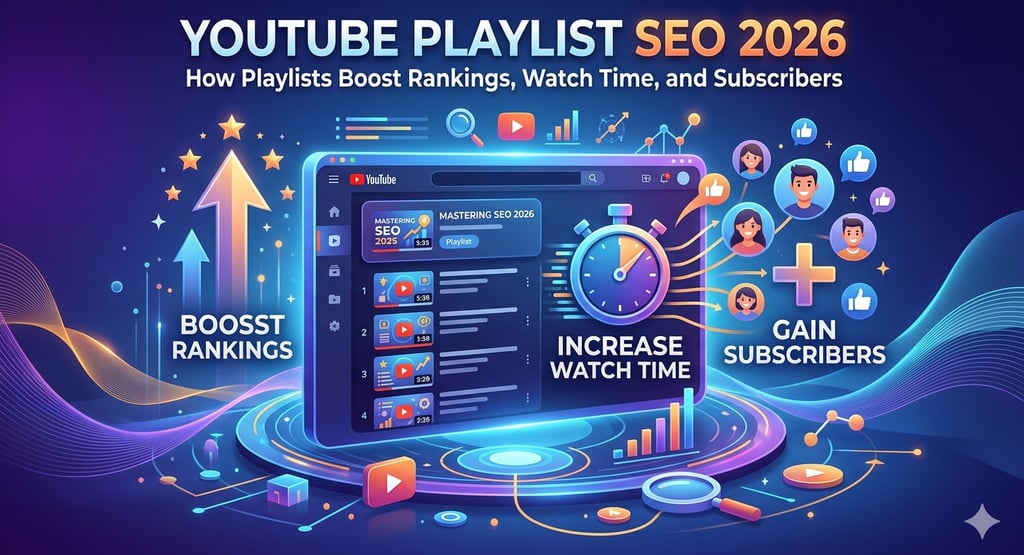
YouTube playlists are one of the most underutilized SEO tools on the entire platform. Most creators use playlists casually — grouping videos into broad categories as an organizational convenience — without understanding that playlists are actually powerful SEO instruments that directly influence search rankings, recommendation frequency, watch time accumulation, and subscriber conversion rates. Channels that treat playlists as a core part of their SEO strategy consistently outperform channels that treat them as an afterthought, and the difference compounds with every video added to a well-structured playlist library.
This guide provides the complete YouTube playlist SEO strategy for 2026: how playlists affect your channel’s algorithmic standing, how to research and optimize playlist titles and descriptions for keyword rankings, how to structure playlists to maximize watch time and the “session watch time” signal that YouTube weights heavily, and how to use playlists as a subscriber conversion mechanism that turns first-time viewers into committed subscribers.
How YouTube Playlists Affect Your SEO and Rankings
To understand why playlist SEO deserves serious attention, you need to understand the specific ways that playlists interact with YouTube’s ranking and recommendation algorithm.
Playlists create their own search results. YouTube playlists appear in YouTube search results independently of the videos they contain. A playlist titled “Free YouTube SEO Tools: Complete Tutorial Series” can rank in YouTube search results for “free YouTube SEO tools” as a playlist result, driving traffic to the entire playlist and increasing the probability that viewers watch multiple videos in a single session. This means that a well-optimized playlist title targeting a specific keyword effectively gives you an additional search ranking entry point for that keyword — supplementing the individual video rankings with a playlist-level ranking.
Playlist views contribute to channel watch time. When a viewer starts watching your playlist and continues through multiple videos, the cumulative watch time from that session contributes to your channel’s total watch time metrics. For channels working toward the YouTube Partner Program’s 4,000 watch time hours threshold, well-structured playlists that encourage multi-video sessions are a direct accelerator.
Session watch time is a premium algorithmic signal. YouTube’s recommendation algorithm specifically values “session watch time” — the total time a viewer spends on YouTube in a session that begins with your video. When a viewer starts a YouTube session by watching your video and then continues watching additional videos (especially from your channel), YouTube attributes that entire session time as a positive quality signal for your content. Playlists that auto-play sequential related videos from your channel maximize session watch time by creating a seamless viewing experience that keeps the viewer watching your content rather than being redirected to a competitor’s video.
Playlists strengthen topical authority signals. When YouTube’s algorithm evaluates your channel’s topical authority in a subject area, it considers not just individual video performance but the collective coherence of your content library. A channel with three well-structured playlists covering keyword research, metadata optimization, and channel analytics signals stronger topical authority in YouTube SEO than a channel with the same videos scattered without organizational structure. Playlists make your channel’s topical depth visible and legible to the algorithm.
Keyword Research for Playlist Titles and Descriptions
The most important and most neglected aspect of YouTube playlist SEO is keyword optimization of the playlist title and description. Most creators title their playlists with generic, non-keyword-optimized labels like “My Tutorials” or “Top Videos” — labels that provide zero keyword signal to YouTube’s algorithm and zero search ranking potential.
A well-optimized YouTube playlist title should follow the same principles as a well-optimized video title: include a primary keyword within the first 50 characters, add a specificity signal that differentiates the playlist from generic category labels, and be compelling to human viewers who might encounter the playlist as a search result.
Use TubeSEO’s Keyword Research module to research playlist title keywords using the same methodology you apply to individual video keywords. Search the broad topic your playlist covers and identify a primary keyword with meaningful search volume. For a playlist covering all your YouTube keyword research tutorial content, a TubeSEO search for “YouTube keyword research” surfaces related keywords like “YouTube keyword research tutorial,” “how to do YouTube keyword research step by step,” and “YouTube keyword research for beginners” — each a potential playlist title keyword with its own search volume profile.
Select the playlist title keyword that best describes the complete content of the playlist, not just individual videos within it. A playlist should have a clear topical scope that is broad enough to contain multiple related videos but specific enough to indicate a precise content area. “YouTube SEO for Beginners: Complete Step-by-Step Series” is an ideal playlist title — it contains the keyword “YouTube SEO for beginners,” the series format indicator, and a completeness signal that encourages viewers to watch from the beginning.
Playlist descriptions deserve the same three-layer treatment as video descriptions: open with the primary keyword in the first sentence, provide a comprehensive overview of the playlist’s content using secondary keywords naturally throughout the body, and close with relevant internal links and a subscribe call-to-action. A 150 to 300 word playlist description provides substantial keyword context that helps YouTube’s algorithm rank the playlist in search results and recommend it alongside related content.
Playlist Architecture: The Four Structural Models
Different content types require different playlist structures to maximize their SEO and watch-time effectiveness. Here are the four most effective playlist architecture models for YouTube SEO channels.
Model 1: The Learning Path Series
The Learning Path Series is a sequentially structured playlist where each video builds on the previous one, creating a complete curriculum for viewers who are new to the topic. This is the highest-subscriber-conversion playlist structure because it gives new viewers an immediate, clear path to follow — “Watch Playlist: Start Here” communicates that the channel has a complete learning journey prepared for them, which is a powerful subscription incentive.
For YouTube SEO content, a Learning Path Series might be structured as: Video 1 — What is YouTube SEO and why it matters; Video 2 — How to use TubeSEO for keyword research; Video 3 — Writing titles that rank; Video 4 — Optimizing your video description; Video 5 — Building your tag strategy; Video 6 — Thumbnail design for CTR; Video 7 — Your first 90-day SEO plan. Each video links naturally to the next, creating strong session continuation signals.
Model 2: The Topic Deep-Dive Collection
The Topic Deep-Dive Collection groups all your videos on a single topic regardless of their sequential relationship. Unlike the Learning Path Series, these videos can be watched in any order — each provides standalone value while collectively covering the topic comprehensively.
This playlist structure is best for intermediate to advanced viewers who are not following a sequential learning path but are looking for comprehensive coverage of a specific topic area. The playlist’s value proposition is depth and completeness: “if you want to know everything about YouTube keyword research, every relevant video is collected here.”
Model 3: The Tool Tutorial Collection
For channels focused on YouTube SEO tools, a Tool Tutorial Collection playlist groups all videos about a specific tool in one place — making it easy for viewers who want to master TubeSEO, for example, to find every tutorial, feature walkthrough, and advanced tip in a single playlist.
Tool tutorial playlists have particularly strong search ranking potential because viewers searching for help with a specific tool represent high-intent, highly specific queries where the competition is low and the viewer satisfaction potential is high. A “TubeSEO Tutorials: Complete Guide” playlist ranking in YouTube search results for “TubeSEO tutorial” captures every viewer trying to learn the tool.
Model 4: The Curated Best-Of Collection
The Curated Best-Of Collection highlights your channel’s most valuable or most popular videos on a topic, irrespective of recency or sequential relationship. “Best YouTube SEO Tips: Top Performing Videos” is a playlist that converts new channel visitors into high watch-time sessions because it directs them immediately to your highest-quality content rather than requiring them to discover it through browsing.
Best-Of playlists are particularly effective when featured on your channel’s home page and when promoted in new video descriptions as “related resources” — they function as a curated introduction to your channel’s best work for viewers who are evaluating whether to subscribe.
Using Playlists to Boost Subscriber Conversion
Beyond their SEO and watch-time benefits, playlists are a powerful subscriber conversion mechanism when used strategically within your video content.
The most effective playlist conversion tactic is the “playlist teaser” CTA — a brief mention within your video that directly references the playlist containing related content. “This video is part of my complete YouTube SEO for beginners series — if you are following along from the beginning, the full playlist is linked in the description” gives the viewer both awareness of the playlist and a specific reason to continue engaging beyond the current video.
Viewers who discover a playlist and start watching from the beginning subscribe at significantly higher rates than viewers who watch a single standalone video, because the playlist experience creates an ongoing relationship with your content over multiple viewing sessions. Each subsequent video the viewer watches from your playlist reinforces their connection with your channel and increases the probability that they subscribe to ensure access to future content in the series.
Feature your most important playlists prominently in your YouTube channel’s customization section — the “Sections” feature in YouTube Studio allows you to display specific playlists on your channel’s home page. New visitors who land on your channel home page should immediately see your most important playlists as organized, compelling reasons to stay and explore your content library rather than encountering an undifferentiated reverse-chronological video feed.
Advanced Playlist SEO Tactics
Create “best for new viewers” starter playlists. A playlist specifically designed for first-time channel visitors — featuring your most widely accessible, high-value videos that demonstrate your channel’s core value proposition — significantly improves subscriber conversion rates for new organic visitors. Label it clearly: “Start Here: YouTube SEO Fundamentals” tells new viewers exactly what this playlist is for.
Optimize playlist thumbnail cover images. YouTube allows you to set a custom thumbnail image for each playlist. Use this feature to create visually consistent, branded playlist thumbnails that signal the playlist’s topic at a glance — the same design principles that make individual video thumbnails effective (high contrast, bold text, clear focal point) apply to playlist thumbnails as well.
Add new videos to relevant playlists immediately after publishing. Many creators add new videos to playlists days or weeks after publication, missing the critical early period when playlist session watch time signals are most algorithmically valuable. Make playlist assignment part of your standard upload workflow — before clicking publish, add the video to every relevant playlist in your library.
Create playlists for your highest-traffic keywords even if they only contain two or three videos. A playlist for a high-priority keyword cluster can be created as soon as you have published two videos in that cluster, with the expectation that future videos will be added as the cluster grows. The keyword-optimized playlist title begins ranking and accumulating authority immediately, and each new video added strengthens the playlist’s algorithmic signal.
Measuring Playlist SEO Performance
YouTube Studio Analytics provides playlist-specific performance data that most creators never examine. Navigate to Analytics and filter by Playlist to see playlist-level view counts, watch time, and traffic sources. This data reveals which playlists are performing as effective session-extension tools and which are not driving multi-video watch sessions.
Playlists with high average views per playlist start (viewers who begin the playlist watch multiple videos on average) are your most effective session watch time generators. Playlists with low average views per playlist start indicate that the playlist structure is not compelling enough to encourage continuation — the sequential logic, video quality consistency, or thematic relevance between videos needs improvement.
Use TubeSEO to research whether your high-performing playlists are targeting keywords with room for additional related content, and use the playlist performance data to prioritize which keyword clusters deserve additional video production investment.
Conclusion
YouTube playlist SEO is a high-leverage, low-competition optimization opportunity that most channels leave entirely unexploited. Well-researched playlist titles, comprehensive playlist descriptions built on TubeSEO keyword research, strategic playlist architecture that encourages multi-video sessions, and deliberate use of playlists as subscriber conversion tools collectively contribute to measurable improvements in search rankings, watch time, recommendation frequency, and subscriber growth.
Invest two to three hours in restructuring your playlist library this week — rename your playlists with keyword-optimized titles, write comprehensive descriptions for each, sequence your content into logical viewing paths, and feature your best playlists prominently on your channel home page. The compounding SEO and audience retention benefits of this relatively small investment will accumulate with every new video you add to your growing library.
Quick Links
Questions? Reach out anytime, we’re here.
Contact
Subscribe
write.tubeseo@gmail.com
© 2026 TubeSEO.in — All Rights Reserved.
We respect your privacy. No spam, ever. Unsubscribe anytime. View our Privacy Policy.